
Diesel Generator Engine Oil Maintenance Check and How to Diagnose?
Your Diesel Generator: A Powerhouse or a Paperweight? A Homeowner’s Maintenance Guide
1.0 Introduction: The Critical Role of Maintenance
A residential diesel generator is a significant investment in your home’s power reliability and security. However, its ability to perform during an outage depends entirely on its condition. Proper, consistent maintenance is the only thing standing between a dependable backup power source and a very expensive piece of yard art. Neglecting your generator exposes it to two primary risks: “wet stacking”, where unburnt fuel clogs the exhaust system from running without a load, and engine seizure, a terminal condition often caused by contaminated or insufficient lubrication. This guide provides the essential knowledge to keep your generator ready for action.
2.0 The Foundation: Your Routine Maintenance Checklist
Consistent, simple checks form the bedrock of a healthy generator. Integrate these tasks into your regular home maintenance schedule.
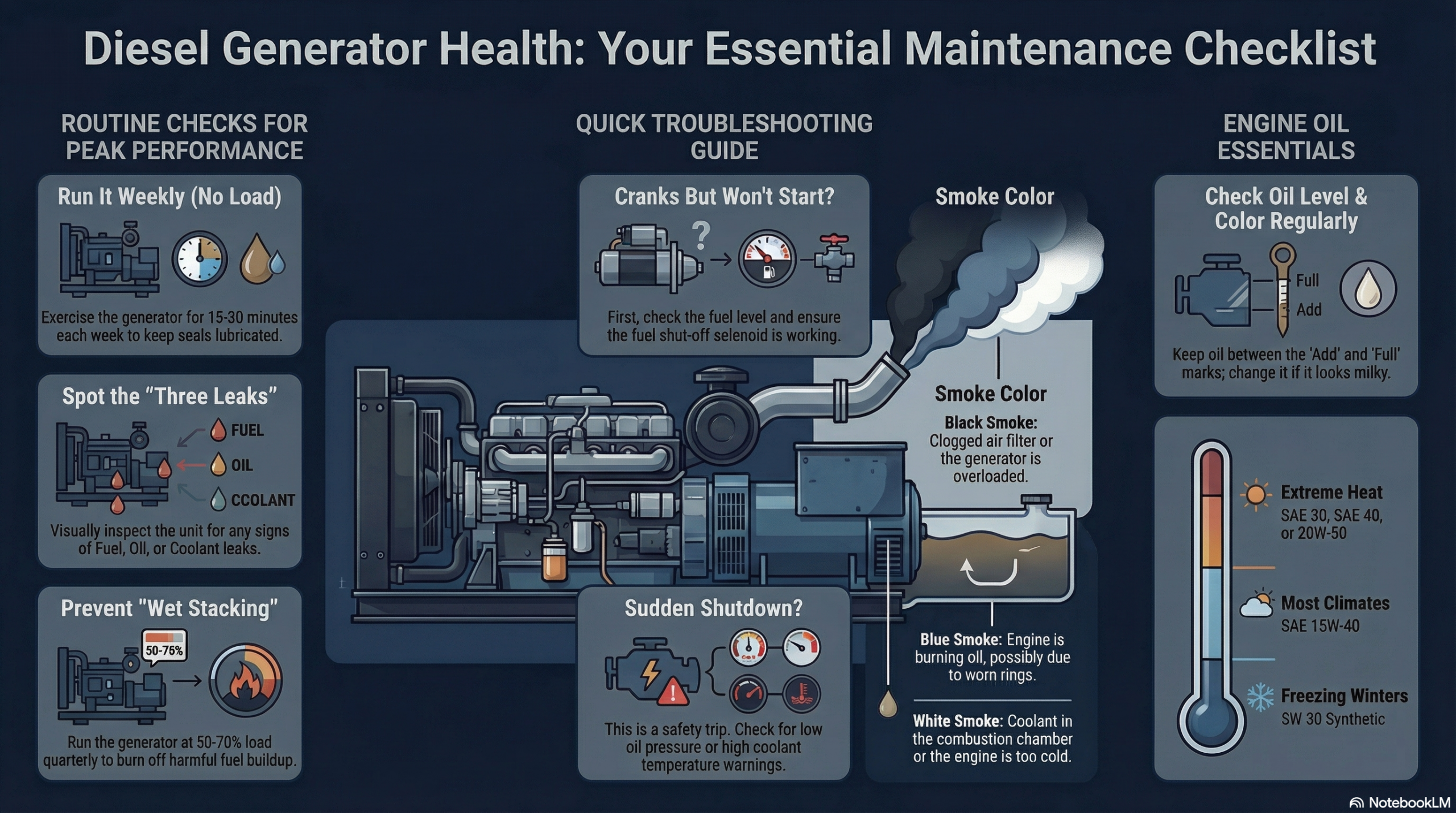
- Weekly Exercise: Run the generator for 15-30 minutes without any electrical load. This has a dual purpose: it prevents the engine’s seals and gaskets from drying out and cracking, and it keeps the starting battery fully charged and ready.
- Visual Inspection: Walk around the unit and look for the “three leaks”: Fuel, Oil, and Coolant. Puddles or drips are an early warning sign. Also, check for any loose wires or signs of rodent activity, as pests can chew through critical wiring.
- Battery Care: Most generator starting failures are directly related to the battery. Regularly inspect the terminals for corrosion (a white, powdery buildup). Clean them with a simple mixture of baking soda and water to ensure a solid electrical connection.
- Fuel Management: Diesel fuel degrades over time. If your fuel is going to sit in the tank for over six months, add a quality fuel stabilizer to prevent it from gelling. Additionally, drain any accumulated water from the fuel filter/water separator monthly to protect your fuel injection system from corrosion and performance-hampering air pockets.
3.0 The Heart of the Matter: How to Check Your Engine Oil
Engine oil is the lifeblood of your diesel generator. Checking it correctly is a non-negotiable task.
- Stop the Engine: The generator must be off for at least 5–10 minutes before checking the oil. This allows the oil circulating in the engine to drain back into the oil pan for an accurate measurement.
- Ensure a Level Surface: The generator must be on perfectly level ground. If it is on a slope, the dipstick will give a false reading, either too high or too low.
- Perform the Dipstick Test: Pull the dipstick out and wipe it completely clean with a lint-free cloth. Fully re-insert the dipstick, then pull it out a second time to get a clean reading.
- Read the Level: The oil level must be between the ‘Add’ and ‘Full’ marks. If the level is at or below the ‘Add’ mark, top it up with the correct type of oil immediately.
- Check the Condition: Look at the oil on the dipstick. Two signs indicate an immediate need for a full oil change, regardless of the level: milky or cloudy oil, which signals water contamination, or an oil that smells like “burnt toast,” which means it has overheated and broken down.
4.0 Playing Detective: Diagnosing Common Issues
Before making a service call, you can often diagnose minor issues yourself with a few simple checks.
- Engine Cranks but Won’t Start:
- Check the fuel level. It is the most common and simplest oversight.
- Check the Fuel Shut-off Solenoid to ensure it is functioning.
- Check for air in the fuel lines, which can happen after a filter change.
- Excessive Smoke:
- Black Smoke: This typically means the engine is getting too much fuel or not enough air. Check for a clogged air filter or an overloaded generator.
- Blue Smoke: This indicates the engine is burning oil. The cause is often worn piston rings or valve seals.
- White Smoke: This can be caused by coolant getting into the combustion chamber (a serious issue) or simply by the engine being too cold during startup.
- Sudden Shutdown:
- This is almost always a built-in safety feature protecting the engine from damage.
- Check the control panel for warning lights, specifically for Low Oil Pressure or High Coolant Temp. Do not attempt to restart the generator. Doing so while a critical fault exists can cause catastrophic, irreversible engine damage.
5.0 When to Call the Pros: Why Authorized Dealers Are Non-Negotiable
While you can handle routine checks, any significant repair work requires a professional. For a modern diesel generator, using an authorized dealer is non-negotiable for four key reasons:
- Warranty Protection: Using a non-authorized mechanic for repairs will, in most cases, immediately void the manufacturer’s warranty on your generator.
- Genuine Parts: As we are an Authorized Dealer of John Deere, Kohler-SDMO, Meccalte & Zonergy, the Authorized dealers use Original Equipment Manufacturer (OEM) parts. These components are specifically engineered to handle the exact heat, pressure, and vibration of your generator model, unlike generic aftermarket parts.
- Software Updates: Modern diesel generators feature digital controllers and Automatic Voltage Regulators (AVRs) that require proprietary software for diagnostics, calibration, and updates. This proprietary software is exclusive to authorized service centers and is required for proper engine and power management.
- Precision: Diesel engines are built with extremely tight tolerances. A task like setting a fuel injector requires precision tools and specifications. An incorrect setting can quickly ruin the engine.
6.0 Choosing the Right Lifeblood: The Best Engine Oil for Your DG Set
Using the correct engine oil for your climate and engine age is critical for protection and performance.
- Standard Recommendation: For most climates and operating conditions, SAE 15W-40 is the standard, go-to oil for diesel engines.
- For Winter / Freezing Temperatures: In areas with cold winters, 5W-30 Synthetic oil is the best choice. It remains fluid at low temperatures, allowing the engine to turn over and start easily.
- For Summer / Extreme Heat: In consistently hot climates, a thicker oil like SAE 30 or 40 (single grade) or a multi-grade 20W-50 provides better protection against oil thinning and pressure loss.
- Engine Age: New vs. Old Gensets: The age and condition of your engine are also key factors. A new engine requires Full Synthetic oil during its break-in period for superior lubrication on fresh components. However, for an older engine with minor oil leaks, Conventional (Mineral) oil can be a better choice, as its larger molecular structure is less likely to seep through aging seals.
7.0 The Long Haul: Understanding Overhaul Timelines
While diesel engines are built for extreme longevity, a residential unit’s greatest enemies aren’t high hours—they’re neglect and inactivity. Here are the typical service intervals:
- Oil & Filter Change: Perform every 100–250 running hours or annually, whichever comes first.
- Top-End Overhaul: This service, which includes tasks like valve adjustments and injector cleaning, is typically needed around 3,000 hours.
- Major Overhaul: A full rebuild involving pistons, bearings, and cylinder liners is not typically required until the engine has run between 12,000 and 20,000 hours.
Key Insight for Homeowners For most homeowners, reaching the major overhaul milestone could take over 20 years. Your engine is far more likely to fail from preventable issues like internal rust or lack of use than from simply wearing out.
8.0 Critical Pro-Tip: How to Prevent “Wet Stacking”
If you only run your generator for its weekly no-load exercise, you are at high risk for a condition called “wet stacking.” This occurs when unburnt fuel and lubricating oil form a gummy, tar-like substance in the exhaust system, eventually clogging it and causing severe performance issues. The fix is simple and crucial.
At least once every 3 months, you must run the generator at 50-70% of its rated capacity for one full hour. This brings the engine up to its proper operating temperature and pressure, effectively “burning off” the harmful buildup and keeping the exhaust system clean.
9.0 Conclusion: Your Key to Uninterrupted Power
Your diesel generator is a significant investment, but its reliability is not a given. Consistent, proactive maintenance is what determines whether it remains a powerhouse or becomes an expensive paperweight. By integrating these simple checks, fluid management practices, and periodic load tests into your routine, you guarantee that when the power goes out, your generator will be ready to answer the call.